


How to Develop Your Own Creative Voice in Embroidery
- Claire Edwards

- Feb 1
- 5 min read
Finding your creative voice in embroidery is a journey that blends skill, intuition, and experimentation. For emerging artists or students, it can feel overwhelming: there are endless stitches to learn, materials to master, and “rules” that seem set in stone. But the truth is, your most compelling work comes when you let go of perfection and allow play, curiosity, and experimentation to guide you.
1. Begin with Exploration
Before you can define your voice, you need to explore. Try working with different threads, beads, fabrics, and even unconventional materials such as shells, concrete, resin, or found objects. Experiment with surfaces that challenge you - rigid boards, driftwood, or textured fabrics. Each material has its own energy, resistance, and personality, and learning how they respond to your hand is the first step in discovering your signature style.
For every project I create, I make samples. This means stitching the same patterns or stitches repeatedly but experimenting with different materials, colours, and combinations. I test, test, and test again - pushing boundaries, playing with colour, and seeing how materials interact. This is where what I call happy accidents often happen.
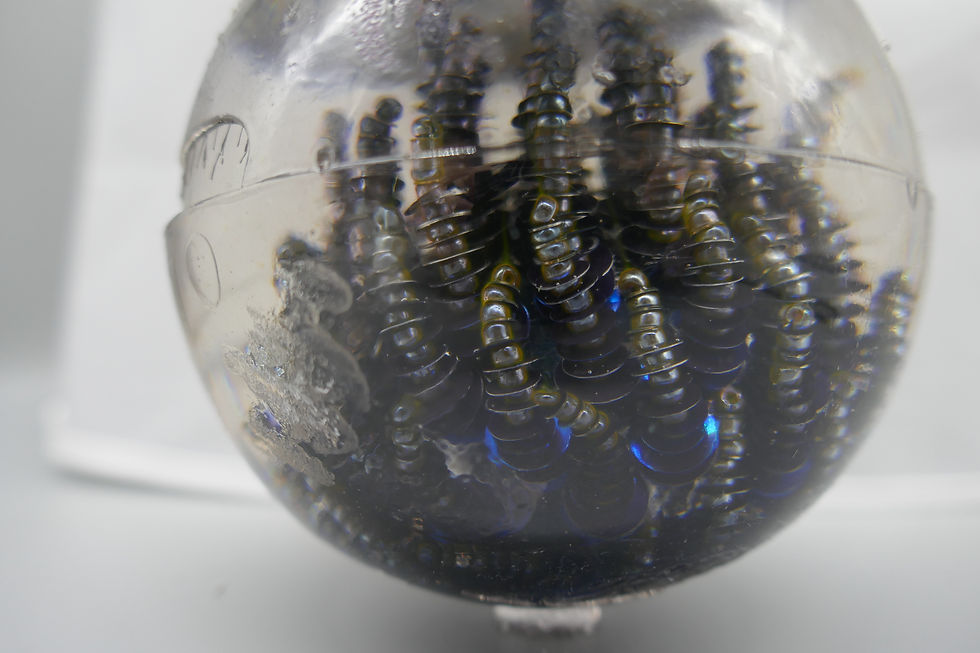
For example, when I was testing how embroidered felt balls react with resin, I placed a large felt ball, embroidered with beads and sequins, into a sphere that had already had a layer of resi-crete and embedded beadwork at the base. I filled the sphere from the hole in the top, and the felt ball floated to the top of the resin, creating the most amazing textural piece - something I hadn’t planned at all.

Don’t get me wrong, not everything is a happy accident. Many experiments go wrong, especially when working with mixed media. I’ve spent countless hours embroidering only to see sequins lose their colour or melt due to the exothermic reaction of resin. Different types of resin behave in unexpected ways with fabric, beads, and threads, and some experiments fail completely. But these “failures” are as valuable as successes - they teach you the limits of materials, reveal new techniques, and often spark ideas that wouldn’t have emerged otherwise.
Don’t be afraid to create pieces that feel messy, unfinished, or “wrong.” These experiments are your laboratory. Mistakes become discoveries, accidents reveal new textures, and these
explorations often guide you toward techniques and combinations that feel uniquely yours. Keep these experiments visible - photograph them, pin them to a board, or collect them in a journal. Over time, you’ll notice patterns emerging: preferences for colour, texture, or certain stitches that signal your personal aesthetic.
2. Embrace Playfulness
As adults, we often approach art with self-imposed rules: the work must be perfect, symmetrical, or “acceptable” according to some external standard. As children, we create freely: we draw outside the lines, mix colours wildly, and stitch without concern for the final result. That sense of play is the cornerstone of discovering your creative voice.
Play is not frivolous - it’s essential. When you allow yourself to experiment without expectation, you free yourself from fear of failure. Try new stitches, layer materials unexpectedly, or mix textures that seem contradictory. Some of your most exciting discoveries will come from these moments of fearless experimentation. Happy accidents often emerge when you let go of control and allow the materials and your hands to interact naturally.
Practical tip: Dedicate a “play sheet” or small piece of fabric each week to free stitching. No rules, no outcome, just stitch and see where your hands take you. Over time, you’ll notice elements that naturally recur and feel authentic to your practice.
3. Observe and Reflect
Developing a voice isn’t just about action; it’s also about reflection. Take time to observe your own work critically and with curiosity rather than judgment. Ask yourself:
Which pieces do I feel most proud of, and why?
Which materials or techniques feel intuitive?
Where did I feel restricted, and where did I feel free?

Keeping a sketchbook, photo journal, or mood board can help you track these insights.
Record textures, colour combinations, or techniques that excite you. Look for patterns - they are clues to your emerging style. Over time, reflection will guide you to the elements that define your creative voice.
4. Break the Rules and Take Playful Risks
Traditional embroidery comes with centuries of expectations, but your voice doesn’t have to conform. Thick threads, oversized beads, chaotic patterns - these “imperfections” are often what make work memorable and personal.

Consider this: some of the most influential contemporary textile artists became known precisely because they challenged the conventional rules. By breaking expectations, you
create space for authenticity and innovation.
Don’t shy away from mistakes - they may become your signature.
Playful risk is where innovation happens. Deliberately challenge conventions: stitch upside down, layer materials in unconventional ways, or allow textures and colours to interact spontaneously. Many happy accidents arise from taking these risks. Even when experiments fail - sequins melt, threads fray, colours bleed - the knowledge gained is invaluable. Every misstep teaches you how materials behave, opening new avenues for creativity.
Exercise: Pick a traditional pattern and intentionally “break” it - add a wild colour, a texture that clashes, or a stitch that doesn’t fit the original structure. Notice what happens. Often, these experiments open doors to entirely new approaches and unexpected results.
5. Combine Skill with Intuition
Technical skill is important, but your voice emerges most powerfully when you balance skill with intuition. Once you’ve mastered the basics, let instinct guide your choices. Your hands know patterns your mind hasn’t yet formalised. Trust them.
Intuitive stitching might mean layering beads where you feel inspired, pulling thread in unplanned directions, or letting texture dictate the rhythm of your work. This combination of learned technique and instinctive creation is where your originality shines.
6. Embrace Impermanence
Your inner critic thrives on permanence and expectation. You might hesitate to start a piece because you fear wasting materials, or you may overthink every stitch. Instead, embrace impermanence: treat each piece as a step in the learning process.
Playful risk allows you to innovate without fear. Some of your most exciting pieces will come from happy accidents, while others may fail completely. Both outcomes are valuable - they teach you about materials, techniques, and your own creative instincts.
Exercise: Set aside a small collection of scraps or leftover materials. Give yourself an hour to create something completely without plan, without concern for the result. Notice how freeing it feels and what emerges when you’re liberated from outcome.
7. Develop Your Story
Your creative voice is more than technical skill - it’s the story behind your work. What draws you to certain materials? Why do you choose beads over thread, resin over fabric? Let your experiences, environment, and personality inform your practice.
For instance, working as a nomadic artist allows place, movement, and impermanence to influence your pieces. Incorporating these elements intentionally communicates a story and gives your work depth. The narrative you embed in your embroidery can be as personal or conceptual as you choose.
8. Be Patient and Persistent
Finding your voice doesn’t happen overnight. It’s a process of ongoing exploration, reflection, and experimentation. Some pieces will feel closer to your voice than others. Others may feel like detours. Embrace all of them - they’re equally valuable.
Over time, your repeated experiments, playful risks, and reflections will coalesce into a style that is recognisably yours. Patience and persistence are as important as creativity itself.
Final Thoughts
Developing a creative voice in embroidery is a journey, not a destination. It requires curiosity, courage, and playfulness, alongside technical skill. By experimenting, making samples, embracing happy accidents, breaking rules, and letting your inner child guide your hands, you’ll discover work that is original, exciting, and unmistakably yours.
Your embroidery is a conversation between your hands, your materials, and your imagination - let it speak freely. Play, explore, break rules, and trust the process. That is how a true creative voice is born.


Comments