


Why I chose full-time van-life (and what i’ve learned so far)
- Claire Edwards

- Apr 8, 2025
- 6 min read
As we near our four-year vanniversary, I find myself reflecting on the journey that led us to choose full-time van life—and all the reasons that made it the right path for us.
It’s a long story, but like many life-changing journeys, it began with a series of life-altering events. For us, it started back in 2013. I was commuting from Shropshire to North Wales for my job as a Children’s Services Manager in the voluntary sector—a demanding but incredibly rewarding role. Between work and a busy family life, I began feeling constantly unwell and fatigued. It got to the point where I sometimes couldn’t even climb a flight of stairs.
Doctors initially thought it was depression, but I knew it was more than that. After nine months of sick leave—interspersed with three failed attempts to return to work—I had to seriously rethink my future.
That reflection led to a spontaneous decision: I applied to university to study 3D Contemporary Jewellery. I was offered a place, but changed my course to Surface Pattern and Textile Design. I had no idea what I was doing—after all, teachers had told me I couldn’t draw—but this degree focused heavily on drawing. And, to my surprise, I discovered that I could draw, and do so many other things too. I fell in love with it. My mind opened up to new experiences, and I began to see the world differently.
Two-thirds of the way through my first year, I got one of those dreaded phone calls. A colleague from Ade’s workplace called to say he was in A&E—he had been assaulted at work. His face was battered, his nose and ribs broken. I brought him home that night, but two days later we were back in A&E—his nose wouldn’t stop bleeding. The details that followed are traumatic and largely blocked from my memory, but he ended up having five hours of emergency surgery to tie off ruptured arteries in his head.
While Ade was in surgery, my youngest daughter was downstairs on the children’s ward, waiting to go into surgery to have a tooth removed due to a massive abscess. It was surreal.
Our lives changed in an instant. Ade changed. My daughters and I became his carers, and we muddled through as best we could. I managed to continue with my degree, and in my final year I specialised in embroidery. I went on to become a multi-award-winning hand embroiderer and textile artist.
Ade was diagnosed with chronic pain and severe PTSD. He’s undergone multiple rounds of therapy, of various kinds. Meanwhile, I leaned on creativity as my own therapy. It helped distract me from the daily stress of caring for someone who had once been so full of life but had become a shell of himself—wracked with panic attacks and socially withdrawn. During this time, I was also diagnosed—properly—with Rheumatoid Arthritis and Fibromyalgia. It wasn’t depression after all.
Despite everything, I carved out a little space for myself in a small room at the end of the kitchen. I lost myself in the repetitive rhythm of stitching, which became a lifeline. I never imagined I’d become a full-time carer in my 40s.

Eighteen months after the assault, the prison service’s governor came to our home and sacked Ade on the grounds of medical inefficiency
And life kept moving forward. I completed my degree with a First-Class BA(Hons), exhibited at New Designers in London, and went on to start a Master’s in Contemporary Embroidery. I won several awards—most notably The Hand & Lock Prize for Embroidery, a prestigious international competition. I’d spent my entire final undergraduate year creating the piece: Rising from the Ashes, a highly embellished phoenix. I designed and made the dress it sits on from start to finish—laser-cut metallic leather, hand-drawn designs, silk-screen printed devoré, heat-pressed burnout, hand-dyed fabrics—then constructed and embellished it with beads and sequins.
The phoenix was my way of telling my story at the time. It symbolises rebirth and renewal—rising from the ashes after destruction, representing the strength it takes to start over and grow through adversity. That’s exactly how I felt. I had lost a career I loved and was carving out a new path, not knowing where it would lead. The irony wasn’t lost on me: I had recently been diagnosed with rheumatoid arthritis—damage in the joints of my hands—yet I was choosing to use my hands to create intricate embroidery, partly as therapy, partly to keep them supple. The phoenix felt like a perfect metaphor. Out of pain and loss, something beautiful and powerful was taking shape.


Rising from the Ashes Phoenix
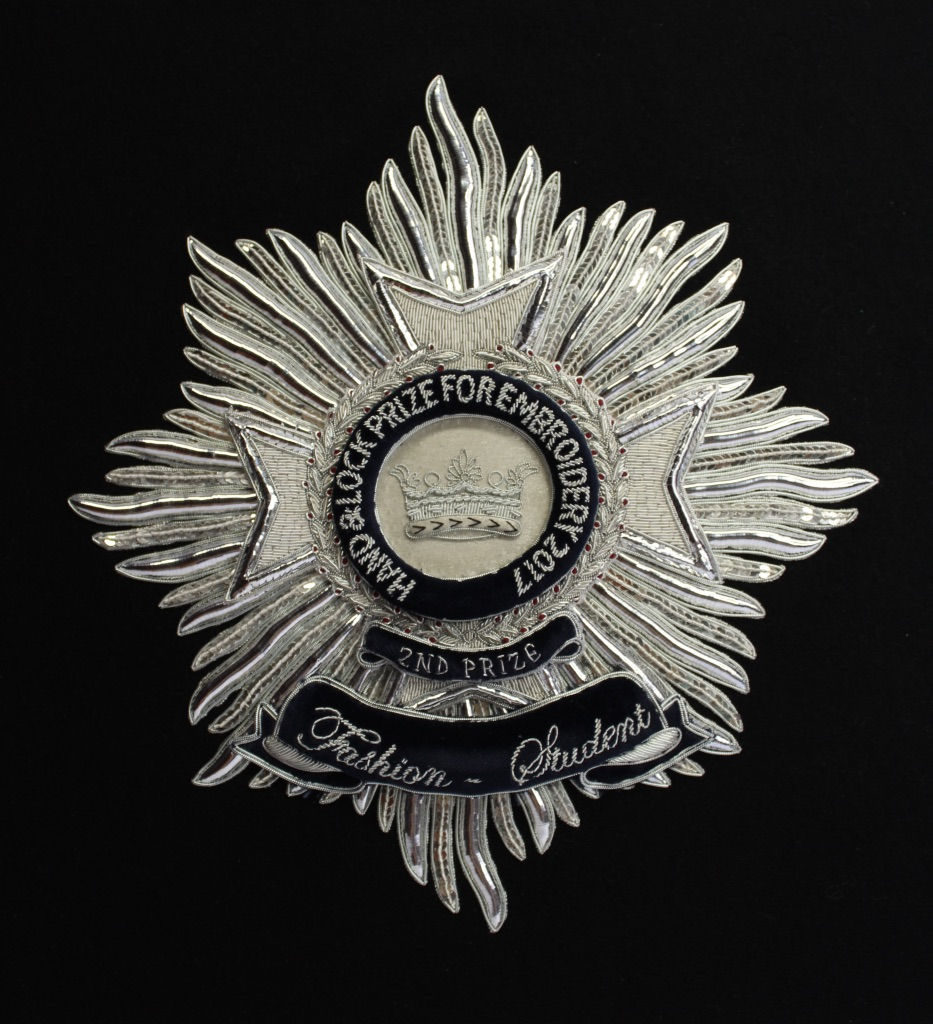
Hand & Lock Prize for Embroidery

University Lecturer & Mentor Colette Dobson
With a complete change in lifestyle, an active effort to understand my illness, and the excellent care of a consultant rheumatologist, my rheumatoid arthritis is now in remission.
Early on, we had decided to get legal support, as Ade had been denied his pension. It turned into a long and gruelling seven-year process that finally went to court in 2021, after being delayed due to COVID. (There’s more to that story later.)
To support Ade’s recovery, we bought a motorhome—something we’d long planned to do anyway. We were too old to keep hauling the kitchen sink to campsites and pitching tents in the English rain. So, in 2018, we bought our first van. It meant we could leave the house for more than a couple of hours. Taking our home with us allowed us to escape to quiet places in nature, away from crowds. Ade was really struggling—he had panic attacks if people walked behind him, and he wouldn’t go anywhere without me. I had to attend every appointment with him. The van also gave me a much-needed change of scenery.
It’s easy to grow resentful when life takes a direction you didn’t choose and there’s no way to change it.
Then the court case happened—and without a doubt, it was the worst experience of my life. I had always been by Ade’s side, but I wasn’t allowed in the courtroom with him due to COVID restrictions. He had to face it alone. I was stuck in a side room, adjacent to the waiting area, where I had to overhear his former colleagues discussing their testimony—despite this being against the rules.
After four intense days in court, the judge reserved his verdict. We had no idea how long the wait would be. That same afternoon, we walked out of the courthouse, phoned the estate agent, and put our house on the market. We’d made up our minds: we were going full-time in the van. We needed to escape the painful memories. Ex-colleagues walked past our house and peered in the windows. If we went out, we felt watched and judged. We needed out.
The house sold the very first day to a cash buyer who wanted completion in ten days. We didn’t have time to be sentimental. We hired a skip, sold what we could on Facebook Marketplace, gave the kids whatever they wanted, and moved into the van parked out back— just using the house as a bathroom extension to the van.

The first sale fell through, but thankfully one of the original viewers matched the offer and it went through. Four months later, the court finally delivered its verdict—we had won. The officers had lied repeatedly to cover their negligence, which had led to the assault. What punishment did they receive? None. In fact, they were promoted. And where is the justice in that? Exactly!
Living in a van isn’t easy—especially when you’re disabled—but we have an enabling partnership. One of the best things about van-life is the ability to change our scenery. Once the blinds are closed, we could be anywhere.
Caring for someone is emotionally exhausting, and I’d be lying if I said I haven’t struggled. The court case destroyed my confidence. The stress leading up to it drained my creativity. It’s taken four years just to begin climbing back to where I was before. In that time, I lost the momentum I’d built after the awards and my Master’s distinction. I felt lost. Even embroidery no longer served as my therapy—the defence team’s treatment of it had shattered that too.
In many ways, our van-life is what’s kept me going. It’s given me something to look forward to. We’ve met incredible people and formed close friendships. I’ve begun to heal. The bitterness from the court case remains, and I still wrestle with how people can lie just to save themselves.
Being a carer to someone with mental health challenges has impacted my own mental wellbeing. Eventually, I sought therapy myself. What I’ve come to realise is that no one really checks in on the carer. The focus is always on the person with the disability.
There are still days when I struggle—when I feel like I’m wasting my talent or losing sight of what I’m capable of. But what I’m slowly learning, and what I have to remind myself daily, is that even though much of my time is spent caring for someone else, I must make space for myself and my creativity. Lately, that’s meant building my website and beginning to share my story more openly through my blog. The next step? It’s time to put myself in front of the camera and invite you along for the ride—to share the world through a creative lens and prove that there’s absolutely nothing we can’t do if we put our minds to it.


Comments